Locking Wheel Nut Removal in Oxford & Oxfordshire
A missing locking wheel nut key turns a ten-minute tyre change into a recovery job — unless someone comes to you with the right extraction tools. We remove locking wheel nuts at the roadside, on your driveway or at your workplace anywhere in Oxford and Oxfordshire, usually within 30 to 45 minutes, and we can fit the replacement nuts at the same visit so it never happens again.
Prefer to know the cost first? See how our pricing works.
What's included
- Assessment of the nut type and the condition of the wheel
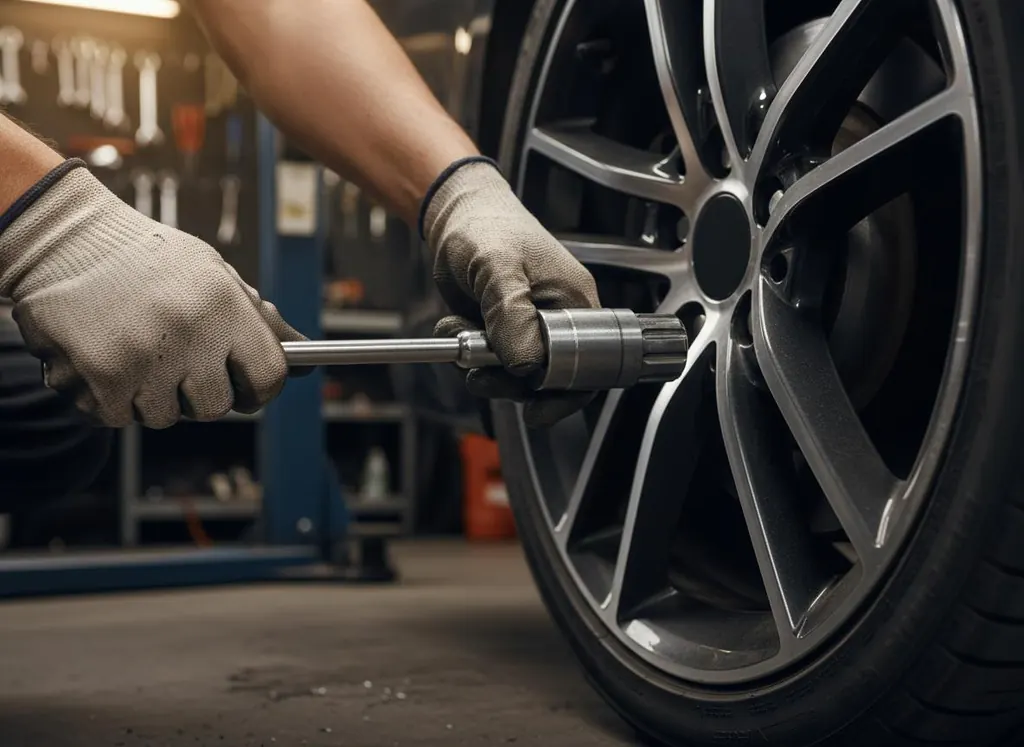
- Non-destructive extraction using dedicated reverse-spiral removal sockets wherever possible
- Removal of all affected locking nuts on the vehicle if you want them gone
- Replacement standard or locking nuts supplied and fitted on request
- Torque-wrench tightening to manufacturer specification
- Any tyre work you need doing while the wheel is off, in the same visit
- No call-out charge
How it works
Tell us the car
Make, model, year and — if you know it — the style of nut. A photo of the nut on WhatsApp saves time and tells us what to bring.
We bring the extraction set
We carry a comprehensive set of removal sockets covering the common OEM and aftermarket patterns.
Extraction
The socket bites into the nut and drives it off anticlockwise. Most nuts come off in a few minutes without touching the alloy.
New nuts fitted
We replace what we removed with standard or fresh locking nuts, torqued correctly, and carry on with the tyre job if there is one.
How non-destructive removal works
A locking wheel nut is a normal nut with a patterned face that only the matching key will grip. When the key is gone, the trick is not brute force — it is a removal socket with a hardened reverse spiral cut into its bore. Driven on hard, the spiral bites into the outer skirt of the locking nut and locks solid, and because the spiral runs the opposite way to the thread, turning it anticlockwise winds the nut straight off.
On the great majority of cars this is a clean job that never touches the wheel. The nut itself is sacrificed — it has to be, because the socket grips by deforming it — which is why we always carry replacement nuts and fit them as part of the work.
The awkward cases, and what we do about them
Not every nut is straightforward, and we would rather tell you that in advance than on your driveway. Three situations need a bit more care.
Recessed nuts sit deep inside the wheel spoke, so a standard removal socket will not reach and the gap between nut and alloy is tight. Free-spinning nuts have a loose outer collar designed to defeat exactly this method — the collar just rotates when gripped, and the nut has to be dealt with differently. And badly rounded or seized nuts, usually the result of someone already having had a go with a hammered-on socket or an impact gun, may have lost the skirt the socket needs to bite.
In those cases we will always try the non-destructive route first. Where it genuinely will not work, we will explain what the alternative involves and what the risk to the wheel is before we do anything, and you decide. We do not start cutting without telling you.
- Recessed nuts deep in the spoke — we use extended-reach sockets
- Free-spinning collar nuts — the collar must be removed before the nut can be gripped
- Already-rounded or over-torqued nuts — assessed case by case, risks explained first
- Corroded and seized nuts — penetrating fluid and heat before force
Why keys go missing in the first place
The single most common story we hear is that the car came back from a service or an MOT and the key was never put back in the boot. The second is that a previous owner never handed it over. The third is that the key sheared — the small plastic-collared keys supplied with many cars are not designed for an impact gun, and a tyre fitted by someone in a hurry with a rattle gun will wreck one.
Once your nuts are off, it is worth deciding whether you want locking nuts at all. They deter opportunist alloy theft, which is a real risk on some models, but they also cause exactly this problem. If you do keep them, note the key code stamped on the key, photograph it, and keep the key somewhere fixed in the car rather than loose in the boot. And ask any fitter to undo locking nuts by hand, never with an impact gun.
Getting the torque right afterwards
A wheel nut that is too loose can let the wheel work itself off; one that is too tight stretches the stud, distorts the brake disc and makes the nut impossible to remove next time — which is how a lot of rounded nuts start. Manufacturer figures for a typical car sit somewhere around 100 to 130 Nm, but it varies by model and we set it to the figure for yours.
We torque every nut with a calibrated torque wrench, in a star pattern, and we will tell you to recheck them after 25 to 50 miles. That is standard advice after any wheel removal, not a sign anything is wrong.
Where we cover for locking wheel nut removal
We are based in Oxford and cover the whole of Oxfordshire plus up to 25 miles beyond, including the A34, A40, A44, A420 and M40 corridors. If you are not sure whether we reach you, call and ask.
Locking Wheel Nut Removal — frequently asked questions
Will removing the nut damage my alloy wheel?
In most cases, no. The removal socket grips the locking nut itself, not the wheel. On recessed or free-spinning nuts there is more risk, and we will tell you what that risk is before we start rather than after.
Can you remove the nut if I am not there?
Yes, provided the car is somewhere we can safely work and you are contactable. Plenty of these jobs happen in a workplace car park while the owner is at their desk.
Do I get replacement nuts?
The locking nut is destroyed during extraction, so it always needs replacing. We carry standard and locking replacements and fit them on the spot — just tell us which you want.
How long does it take?
A straightforward nut is a matter of minutes. Allow around 20 to 30 minutes on site for the job including refitting and torquing, longer if all four wheels need doing or the nut is a difficult type.
My key is snapped in the nut. Can you still help?
Usually yes. We extract the broken key fragment first, then remove the nut in the normal way. Send us a photo on WhatsApp so we can see how much of the key is protruding.
Can you do this at the same time as fitting a tyre?
That is most of our locking nut work. The wheel has to come off either way, so we remove the nut, do the tyre, and fit new nuts in one visit.
Useful reading
Other services
- Mobile Tyre FittingNew tyres fitted and balanced at your home, your workplace or the roadside — no garage visit, no waiting room.
- Puncture RepairA proper internal repair to British Standard BS AU 159 where the damage allows it — and an honest answer where it does not.
- Emergency Tyre ReplacementBlowout, pothole damage or a shredded tyre at 2am — we carry stock, we work nights, and there is no call-out charge.
- Mobile Jump StartCar will not turn over? We come to you, start it properly, and tell you whether it is the battery or something else.
Need locking wheel nut removal now?
We are available 24/7 across Oxford and Oxfordshire, and we will quote you before we travel.